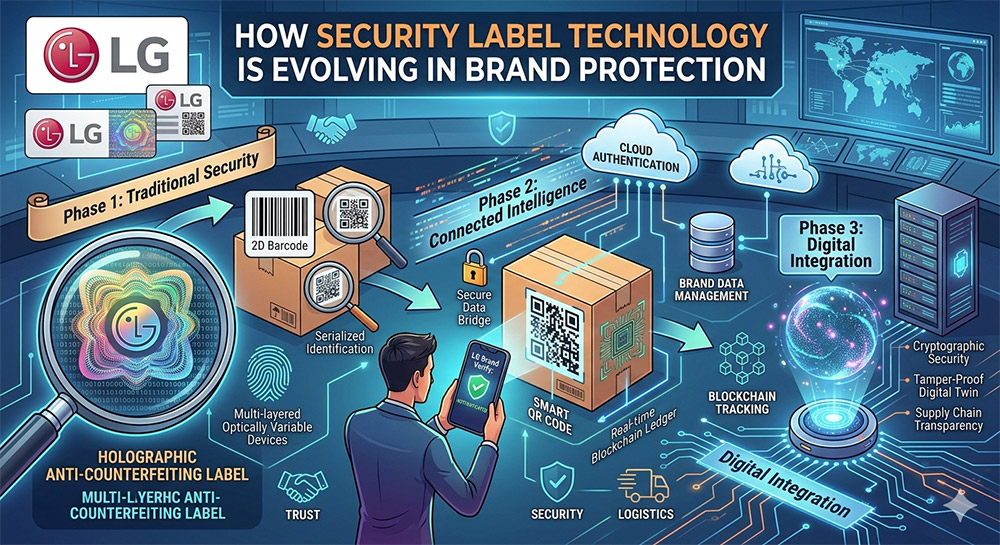
In the high-stakes game of cat-and-mouse between brand owners and counterfeiters, the "mouse" has become faster and more sophisticated. Yesterday’s high-security features are today’s standard commodities. To stay ahead, the security label industry is undergoing a radical technological evolution, moving away from static images toward dynamic, multi-layered defensive systems.
Traditional holograms are being replaced by OVDs (Optically Variable Devices) that offer microscopic precision.
Electron-Beam (E-Beam) Lithography: Unlike standard laser holography, E-Beam technology allows for resolutions up to 0.1 microns, creating hidden images and kinetic effects that are physically impossible to replicate with commercial printing equipment.
Micro-Lenticular Arrays: These labels use tiny lenses to create 3D depth and "floating" images that move when the label is tilted, providing an in-tuitive yet high-security authentication method for the end-user.
The "material" of the label itself is becoming intelligent. We are moving beyond simple paper and film into functional substrates.Thermochromic and Photochromic Shifts: Labels that change color instantly when touched by human heat or exposed to specific UV wavelengths.
Fragile Substrates: Evolution in "ultra-destructible" films ensures that a label will vibrate or crumble into tiny fragments if any attempt is made to peel it off, making "label switching" (placing a genuine label on a fake product) a technical impossibility.
Security label technology is no longer a peripheral concern—it is the frontline of brand defense. As we move toward a future of AI-driven counterfeiting, the labels of tomorrow must be smarter, tougher, and more digitally integrated than ever before. For manufacturers, the goal is clear: to provide a solution that is easy to verify but impossible to clone.